What inspired you to create jewellery?
I worked for a long time as a curator, but predominantly in fashion and product design. When I started to think about going back to do a Master's in design my original thought was that it would probably be in clothes. But then, the more I thought about it, the more I realised, after years of talking about British education to aspiring designers all over the world, the experience of going to a school like the Royal College of Art or Central Saint Martins would be irreplicable. I looked into a product design Master's degree at Saint Martin’s where Simon Fraser, who runs the course and who I had known professionally for some years before, asked me whether I’d ever thought about designing jewellery. I don't really wear very much jewellery at all, myself. I was like, "Well, not really." He said: "Why don't you just let that idea settle with you."
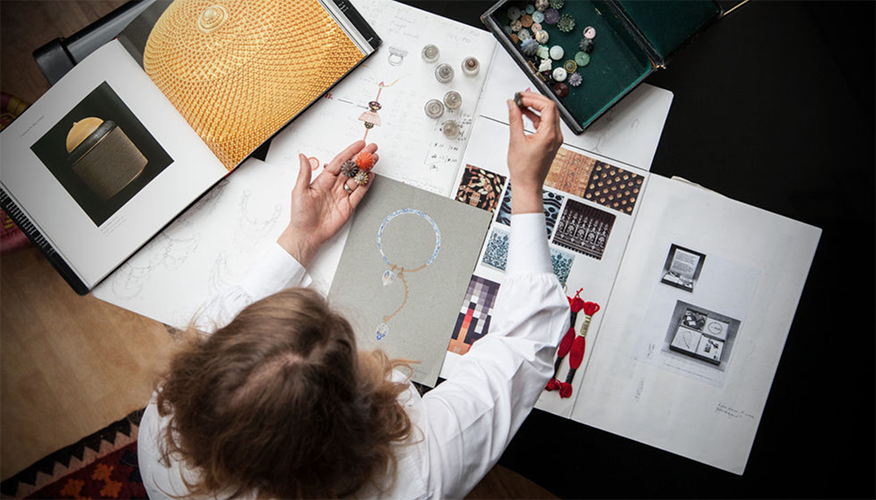
I thought about it for a little while. The turning point was a trip to a museum in the Mehrangarh Fort in Jodhpur. There, I found a jewellery box featuring an enigmatic inscription.
It said: This jewellery box would have contained all the things that a royal woman would have required for the ritual of Solah Shringar.
It didn't say what that ritual was or what the “things” were that she would have required. It was just the box that was there. The idea that a box contained things that are transformative, was something that I found fascinating. I guess it all started from there really. I was interested in the idea of what constitutes a sacred space, what rituals might do for us in our everyday lives and how to translate that into jewellery.
That’s a fascinating story. As a designer what is your ethos and how do you hold onto this throughout your creative process?
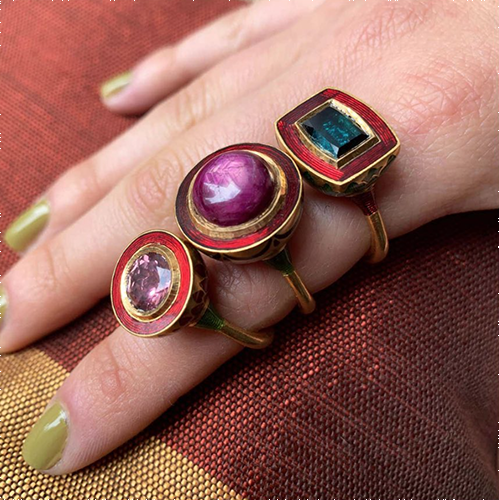
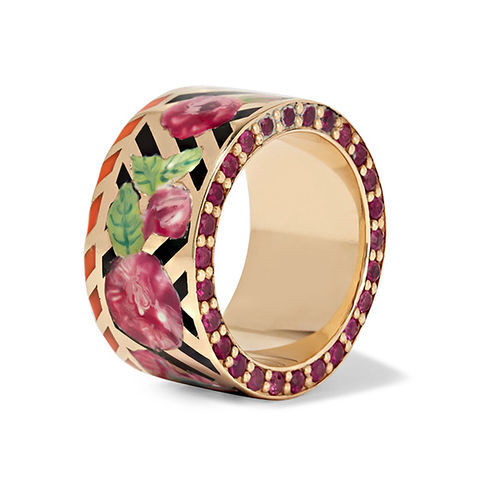
Collaborative storytelling, I guess, underpins a lot of it. What I bring to my practice of design, which perhaps is different from others, is that as a curator I spent decades collaborating with other people to tell stories. Sustaining skills is also important to me. If we don't value them, they will die. And when they die, it's not just, "Oh, isn't it sad that people don't do enamel jewellery in Jaipur anymore?" It is more the decimation of an industry that still constitutes, economically, a huge amount of turnover for that city. It is part of its cultural identity and why people go there from overseas. Sadly, we don't value people's artistry and their commitment and dedication to their craft anymore.
Do you see CAD or 3D printing wax technology and other modern processes replacing traditional craftsmanship? Or do you think a space for original craftsmanship will continue to exist?
They’re just tools and tools are only as good as the people who wield them. If a talented master jeweller uses CAD and 3D printing wax technology to create work for you, then the resulting work will be superlative. It might also mean that he or she is quicker than before. But remember, it's still only a tool. And those technologies do bring some cost efficiency into the process. Making a handmade jewellery object is considerably more expensive because it just takes longer. Technologies are not the sole solution. They are not magic. Like anything, they're only as good as the people who use them. So, if you work with someone who is trained to use CAD but doesn't know anything about jewellery, you're probably going to get something that isn't great, and that doesn't help anybody.
Looking back over the last year, obviously, it's been challenging for designers and so many other different businesses and companies. Specifically, what impact has the last 18 months had on you as a designer?
I suppose what I hope is that it [what’s happened with Covid-19] might result in a re-evaluation of what's important and encourage people to invest and support the creativity and ethics that they believe in. I think my hope is that this way of thinking will increase so that people are less inclined to spend money with businesses that don't share their values, passions, or commitments.
With its standardised platform and its purpose of creating a community in the jewellery industry, what was it that appealed to you about becoming associated with NouvelleBox?
The reality for a lot of small businesses like mine is that many stores approach us asking for consignment. It is very difficult to make that business model work within the framework of a traditional agency.
NouvelleBox gives smaller businesses the opportunity to build their own connections with clients without having the worry of paying an agent. It is a way of expanding the base that you’re operating from. You can build your own relationships, and you can grow slowly and safely. I think it is what the jewellery business needs. What's quite interesting about it so far, for me, is that there are lots of different stores that I have never come across, now under the NouvelleBox umbrella.
What did the process of approaching a retailer look like for you before NouvelleBox? How did you go about promoting your work to retailers and what steps do you take now?
I’ve found that both retailers and press tend to quite like discovering you on their own. Reaching out aggressively to stores is something they experience daily. So, I've always approached it by trying to do really good work and hoped that people will like it. If you're any good at what you do, they'll know about you anyway. I feel like I'm in the very luxurious position of making work that has its own voice that's quite distinctive. If you're making something a bit more generic, then you do have to reach out aggressively to stores to give them lots of good reasons why they should buy you over somebody else who could be similar.
When they reach out to you, it saves time, because presumably at this point, they've already decided that you might have something to offer their customer and that there may well be a place for you in their store. Therefore, the conversation on both sides is less likely to be a waste of time than it might otherwise be.
As a designer who works closely with craftsmen in India what are the sustainability and environmental considerations that inform your design practice?
I guess the reality is when you're working with very small-scale craftsmen in Jaipur, you can't really guarantee or trace where the gold comes from or the mine the stones come from. If people want ethical gemstones I know where to source those, and I know where to have things cast with Fairtrade metal, where we can tell you exactly which mine the metal comes from. So, we can make things in recycled metal as well. Although most metal is in fact recycled anyway. It is all possible. However, I guess I'm much more interested in skill sustainability than I am in the other side of the story.
During the difficulties of the last 18 months some larger companies have struggled with change while some smaller ones have done quite well. Do you think it's time for the jewellery industry at large to become more adaptable, learning from the experience of small designers and start-ups?
I don't know whether they should or not. That's for them to decide. I think what's interesting is that as with all moments of creative destruction, new ideas come forward, and these can either be adopted or not. However, I do think that the kind of business model where it’s about making thousands of the same thing and shoving a logo on it, is dead. So, it's just a matter of time to see how long those big companies take to figure this out.
Contributors
 Darren Hildrow
Entrepreneur & Business Strategist+ MORE FROM Darren Alice Cicolini
 Elisa Anniss
Jewellery & Accessories Editor/Copywriter+ MORE FROM Elisa