Kyle Roderick: The Earthly Power of Natural Diamonds

While differences between natural diamonds and lab-grown ones may elude the naked eye, experts readily identify natural vs. lab-grown or synthetic diamonds by analyzing them with precision spectroscopic instruments. While some lab-grown diamonds may cost far less than ones mined from the earth, “Real diamonds are, and always will be, preferable to any lab-grown diamonds,” asserts Soraya Cayen, owner of Cayen Collection, a Carmel, CA. high jewelry and fine jewelry boutique.
Renowned for her eponymous natural diamond jewelry line, plus rare and one-of-a-kind pieces by U.S. luxury designers like David Webb and Victor Velyan, Cayen also carries natural diamond jewelry by French designer Sylvie Corbelin and Italian diamond jewelry collections by Etho Maria and Picchioti. “Sparkling gifts of planet Earth, natural diamonds are organically and philosophically different from those made in a lab,” Cayen claims. “Formed from carbon which crystallized under enormous pressure and intensely high temperatures over three billion years,” she continues, “diamonds are miracles of nature and of geological time. They are objects of beauty, and some diamonds happen to embody vast monetary market value.” As Cayen notes, however, “lab-grown diamonds are industrial products that hold almost zero resale value as compared to naturally mined diamonds.”

As Jean Ghika, Global Head of Jewelry at London-based Bonhams auction house explains, “It’s difficult to differentiate between a natural diamond and a lab-grown equivalent without the assistance of a gemological laboratory. While both are chemically identical,” she notes, “one is made by humans, whilst the other spent millions of years evolving inside the earth’s mantle.”
The evidence-based worth of lab-grown diamonds is illuminated by how they are rated on the secondary or estate jewelry market. In this market, lab-grown stones are appraised by gemologists and dealers as holding negligible, or zero resale value. Thus, they are generally never up for auction at established auction houses.
Because high quality naturally mined diamonds are beautiful and relatively rare commodities, Ghika continues, “Superior quality diamonds command correspondingly high prices and are without question the most popular stone at auction.” While Bonhams never trades in lab-grown or synthetic diamonds, she continues, “We have more requests for natural diamonds, and we sell more naturally mined diamonds at Bonhams, than any other gemstone,” Ghika reports. “The optical qualities of diamonds,” she concludes, “including adamantine luster, natural beauty and durability, make diamonds the ideal choice for everyday wear.”

Our ancient ancestors felt the same way. Originally mined in the 4th century B.C. and first worn by Indian royals, “Diamonds have always literally embodied the meaning and power of resilience,” says Latondra Newton, designer, jeweler and owner of the Los Angeles-based brand Stôn, which features natural diamond crystals and rose cut diamonds in women’s and men’s luxury collections. “This is because they’re the hardest natural substance found in the earth. Due to their beauty and unequalled strength,” Newton explains, “Diamonds have been valued and worn as talismans for millennia to ward off evil. Diamonds will always be loved and sought after because they make humans feel so cherished, protected and powerful,” she claims.
Tayloe Piggott, owner of Jackson, Wyoming’s Tayloe Piggott Jewelry, agrees, adding that real diamonds ignite deep and enduring emotional responses that lab-grown stones or other synthetics can never hope to tap. “The emotions that real diamonds bring to the world outshine their brilliance,” says Piggott, “and the story behind a real diamond’s origins often enhances the character of a finished piece.” Piggott sells diamond jewelry by U.S. designers such as Nicholas Varney, Todd Reed and Monique Péan. Regardless of their cut or color, real diamonds contain and project “a purity and elegance that is absent from lab-grown stones,” Piggot says.

Significantly more valuable than lab-grown stones due to their rarity, geological purity and organic origins, real diamonds are becoming more valued as life become increasingly virtual and reliant on mass-produced synthetic materials. According to Jane Carter-Getz, owner of the Jackson, Wyoming jewelry store Belle Cose, “Humans naturally and instinctively desire to see and feel rare beauty.” Offering colorless, champagne and black diamond jewelry by Temple St. Clair and Roberto Coin, Carter-Getz explains, “We naturally love and value rare diamond jewelry made with earth-mined diamonds more than we do mass-produced pieces made with lab-grown or simulated diamonds.”
Likening key differences between real and lab-grown diamonds to those “between a meal prepared by a fine chef consisting of organic ingredients versus one made with industrially farmed food processed in a factory,” Carter-Getz asserts, “While the two meals may look fundamentally the same at first glance, the factory-made meal will never embody the same quality of taste, artistic technique, authenticity and story of the organic one. Each type of diamond embodies a different story and tells a different story.”
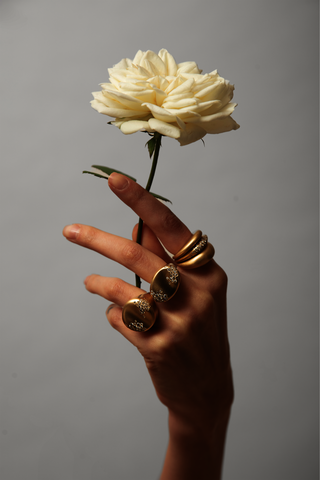
Speaking of stories, Paris-based designer Sylvie Corbelin, whose rare and one-of-a-kind jewels are sold at her eponymous boutique in Marché Paul-Bert Serpette on rue des Rosiers, notes, “Dramatic, romantic stories of real diamonds are tightly woven throughout the tapestry of human history.” Humans value real diamonds so very greatly, Corbelin suggests, because the epic geological story of diamond creation intersects with humanity’s innate drive to create meaning through storytelling. “In the kingdom of the human imagination,” Corbelin continues, “diamonds serve as sparkling windows into love affairs, life passages and family heritage.” Corbelin, whose discerning clients include the King of Morocco and Academy Award-nominated actress Jennifer Tilly, states, “I only use natural elements for my creations so I am really not interested in using lab-grown diamonds. I believe that for an important purchase such as an engagement ring, anyone would prefer a real diamond.”
In other words, “Real people and true love always deserve real diamonds,” Corbelin claims.
According to Cayen, “Between natural diamonds and those made industrially, there are differences in geology, rarity, emotional power and economic value. Lab-grown diamonds,” Cayen explains, “are cranked out in a matter of weeks as opposed to the billions of years that it takes for a real diamond to develop. Because there’s nothing poetic or romantic about an industrially made stone as opposed to a naturally formed diamond,” she states, “serious jewelry collectors, estate jewelers and prestige auction houses see zero symbolic or monetary value in lab-grown diamonds.”
Contributors
 Kyle Roderick
Founder / Editor-in-Chief at BIJOUXreview.com+ MORE FROM Kyle